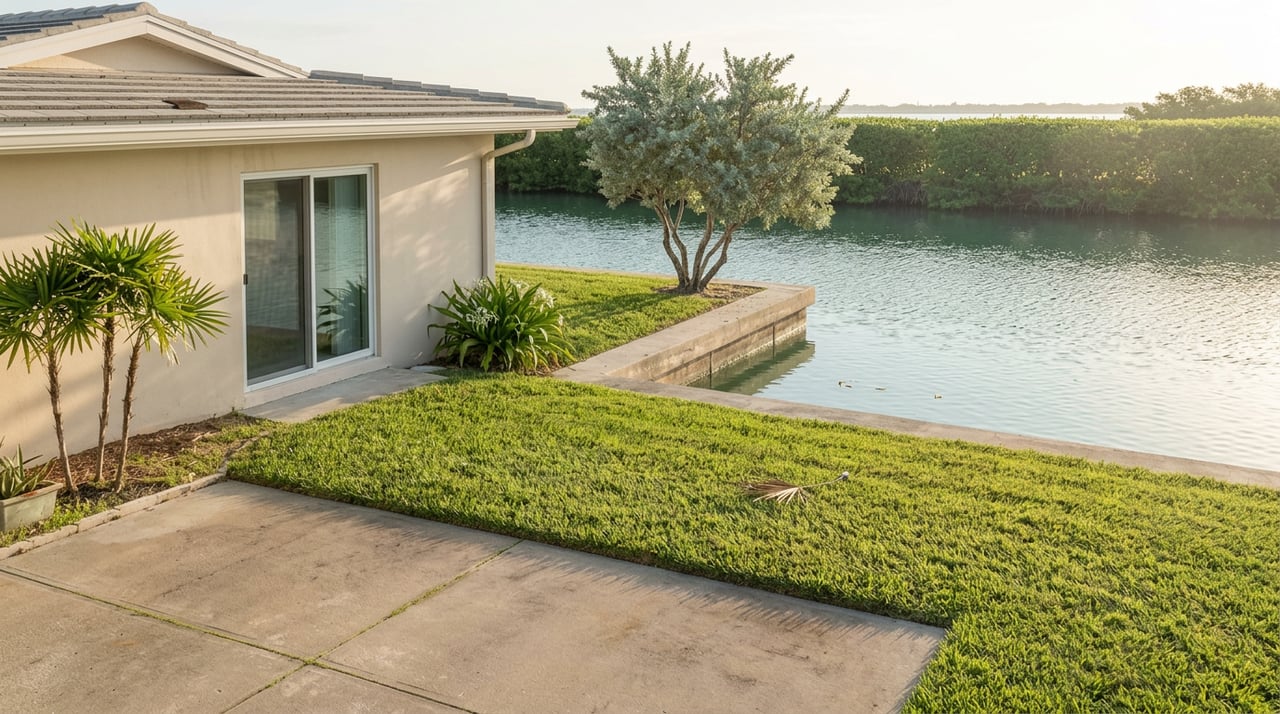
Royal Oak Hills Waterfront Homes Ocean Access Explained
August 27, 2026
August 27, 2026
A dock for rent on the El Rio Canal, in the same stretch of East Boca that runs through Royal Oak Hills, advertises itself plainly: direct access to the Intracoastal and the Atlantic Ocean. Then, in the same listing, a detail worth noting: one fixed bridge limits boat size to 35 feet.
That listing detail raises an important question about what "waterfront" means in Royal Oak Hills. Across the neighborhood, ocean access gets treated as one amenity, present or absent, priced as a flat premium over the dry-lot homes a few streets away. But access to the ocean from a canal-front dock isn't binary. It depends entirely on what physically stands between that specific dock and the inlet, and in at least part of Royal Oak Hills, what stands there is a bridge that never opens.
The neighborhood-wide numbers look healthy on their face. In the twelve months ending July 2026, eleven Royal Oak Hills homes changed hands at an average sold price of $995,523, or about $381 per square foot, with homes averaging 68 days on market and a 97 percent list-to-sell ratio. That's a market where sellers are getting close to what they ask.
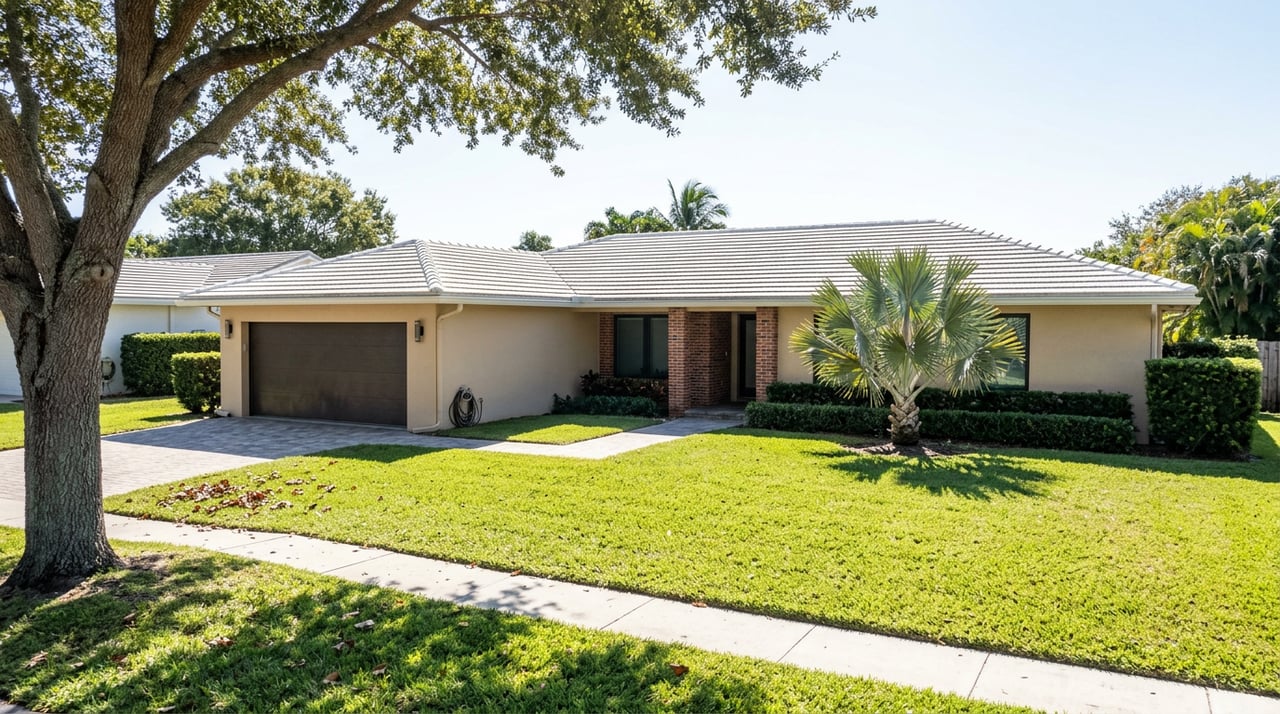
Buried inside that average, though, is a much wider split. As of April 2026, waterfront homes on the El Rio Canal were trading closer to the $1 million mark, while the neighborhood's non-waterfront ranch homes, built from the same nine original 1960s floor plans, were changing hands in the $600,000 to $800,000 range depending on size and condition. That's roughly a $200,000 to $400,000 gap between a house with canal frontage and the identical house a block inland.
Here's what the average obscures: that premium gets paid for the promise of "ocean access," not for a verified, dock-specific vertical clearance. Two waterfront listings a few doors apart can carry the exact same asking price language and mean two very different things once a boat is actually involved.
| Waterfront (El Rio Canal) | Interior / dry lot | |
|---|---|---|
| Typical 2026 price range | Around $1,000,000 and up | Roughly $600,000 to $800,000 |
| What the price includes | Canal frontage, private dockage | Same original ranch floor plans, no canal frontage |
| HOA involvement | Voluntary HOA, no dock fees charged to owners | Voluntary HOA, no dockage relevant |
| What the listing typically states | "Direct ocean access" | Not applicable |
| What to verify for each dock | Which bridge, if any, sits between the dock and the inlet | Not applicable |
A voluntary HOA runs the block parties and community events in Royal Oak Hills, but it doesn't charge dock fees and it isn't in the business of certifying bridge clearances for individual addresses. That leaves buyers responsible for verifying what a specific dock can accommodate.
Getting from a Royal Oak Hills dock to open water means passing through a chain of infrastructure, and not all of it works the same way. The city of Boca Raton maintains four public drawbridges along its canal and Intracoastal system, including the Camino Real and Palmetto Park Road spans that flank the neighborhood on its south and north borders. Those are movable bridges. They open on a schedule or on demand, which means a boat with real height, a flybridge cruiser or a sailboat with a tall mast, can still get through. It just has to wait for the span to lift.
Farther out, the Boca Raton Inlet itself is crossed by the Boca Raton Inlet Bascule Bridge, which carries A1A traffic and opens every quarter hour from 7 a.m. to 6 p.m., and on demand at other times. Its closed vertical clearance is about 23 feet, but because it's a movable span, that number only matters if you're trying to time a transit between openings.
A fixed bridge is a different animal entirely. It has no schedule, because it never moves. Whatever its vertical clearance is at a given tide, that's the ceiling, permanently. The dock listing referenced above sits on the interior canal system that feeds toward the Intracoastal, and it names a fixed span as the reason a 35-foot limit applies to that particular address. Waiting doesn't help. Tide helps only marginally, since clearance under a fixed bridge shifts by a foot or two at most between high and low water.
A 35-foot boat-length limit puts a buyer at the upper edge of a large center console or a small sportfisherman and excludes boats longer than 35 feet. Bridge clearance is a separate question: 40-to-60-foot flybridge cruisers commonly need 12 to 22 feet of air draft depending on their tower and antenna arrays, and sailing yachts often carry more than 40 feet of mast height even at modest lengths overall.
None of this shows up in an MLS field or an average price per square foot, because those systems record "waterfront" as a checkbox, not a graduated fact. A dock capped at 35 feet and a dock with a clear run to the inlet get filed under the same label and, often, priced within the same range, so buyers may need to check the dock-specific details.
The neighborhood's development history helps put its canal system in context. The canal wasn't a natural feature the developers built around. According to the community's own historical record, developers Burt Haft and Jack Gaines purchased the land in October 1959 and struck an agreement with the Lake Worth Drainage District the following month to establish a canal on the site, with electricity following in October 1960. The canal was established as part of the development of a residential subdivision whose history begins with nine model homes. The fixed crossings are why a buyer shopping in 2026 can't assume a canal address behaves like open water.
If a boat is part of the plan, treat the phrase "ocean access" as a starting question, not a finished answer, before writing an offer.
Does every waterfront home in Royal Oak Hills face a 35-foot limit? Not necessarily. The constraint applies where a fixed bridge sits between a given dock and the inlet, and that's a fact tied to a documented address on the canal, not a blanket rule for the entire neighborhood. Verify it dock by dock rather than assuming it applies everywhere, or nowhere.
Will the Camino Real and Palmetto Park Road bridges block a taller boat? Those two spans are movable drawbridges that open on schedule or on demand, so they cost a boater time, not clearance. A fixed bridge is the one constraint that scheduling can't solve.
Does the Royal Oak Hills HOA handle bridge or canal maintenance? No. The voluntary HOA organizes community events and doesn't charge dock fees, but it isn't a canal authority. Confirming clearance, depth, and condition on a specific route is the buyer's responsibility, ideally before the inspection period ends.
If you're weighing a waterfront purchase in Royal Oak Hills, or trying to figure out what a specific dock on the El Rio Canal is actually worth once bridge clearance enters the picture, The Bahn Group can walk the numbers with you before you write an offer.
This article is general information, not legal, tax or financial advice. Consult a qualified professional about your situation.
Stay up to date on the latest real estate trends.
Brian has a reputation for consistently carrying one of the most impressive luxury listing platforms in the marketplace. Contact Brian today for a free consultation for buying, selling, renting or investing in Boca Raton, Florida.