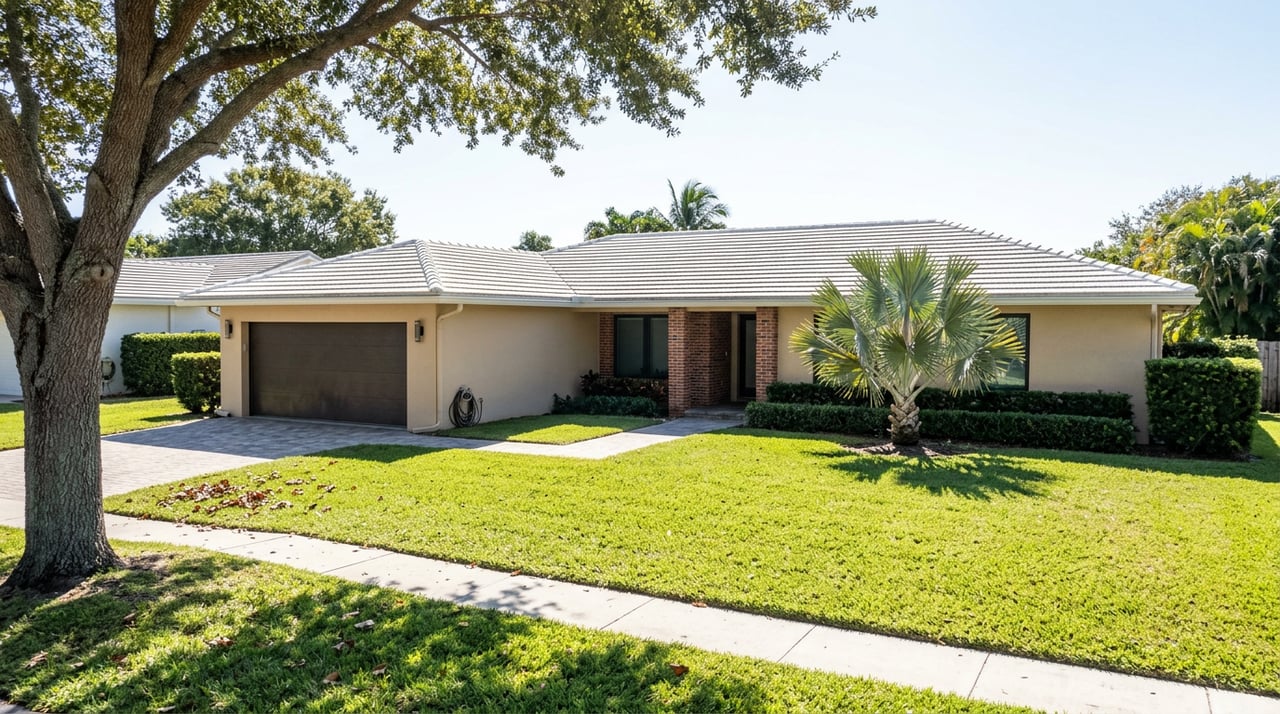
The Camino Gardens Median Price Is Averaging Two Markets That Don't Talk to Each Other
September 3, 2026
September 3, 2026
Two homes closed in Camino Gardens within the same 12-month stretch. One, a 2,107-square-foot house on Walnut Terrace built in 1974, sat on the market for 145 days and finally sold 20 percent below list at $420 a square foot. The other, a 2,170-square-foot house on Elm Tree Lane built in 1967, moved in 30 days and closed at $620 a square foot, just 4 percent under ask. Their construction dates were close, but the outcomes were not. Same 400-home subdivision. Same tree-named streets and white roofs that give this East Boca neighborhood its uniform look. Nearly a 50 percent gap in price per square foot and a 115-day gap in how long it took to sell.
If you've been shopping the portals for a Camino Gardens price trend, you've probably already run into a number that felt too tidy to explain what you were seeing in the actual listings. That's because it is.
Pull up Camino Gardens on three different real estate data pages and you'll get three different answers about which direction prices are moving. One snapshot shows the trailing 12-month median flat year-over-year at $1,335,000. Another, pulled at a different point in the same general window, shows it down 2 percent to $1,317,500. A third shows it down 14 percent to $1,285,000. All three are describing the same small neighborhood over roughly the same stretch of 2025 and 2026.
This isn't a data error. It's what happens when a median gets calculated from a genuinely tiny sample. Brokerage MLS activity for Camino Gardens shows roughly 23 homes changing hands over a trailing 12-month period as of June 2026, with an average asking price near $1.51 million against an average selling price near $1.43 million, a list-to-sell ratio of about 94 percent. When your annual transaction count sits in the low twenties, one or two unusually large or unusually distressed sales can swing the median by tens of thousands of dollars, and the headline number will bounce accordingly depending on exactly which month you pull the data. A single trophy-lot closing or a single stale listing that finally sells at a steep discount reshapes the whole picture.
That's the first thing worth knowing before you use any single Camino Gardens median to size up a deal. The second thing, and the more useful one, is what's actually driving the spread underneath that unstable number.
Here's a sample of closed activity from the same general window that produced those conflicting medians.
| Address | Built | Square Feet | Sale Price | Price/SF | Days on Market | Sold Below List |
|---|---|---|---|---|---|---|
| Elm Tree Ln | 1967 | 2,170 | ~$1,345,000 | $620 | 30 | 4% |
| Unlisted, East Boca | 1968 | 3,498 | $2,875,000 | $822 | 43 | 12% |
| SW Tamarind Way | 1967 | 2,833 | ~$2,193,000 | $774 | 0 | 12% |
| Walnut Terrace | 1974 | 2,107 | $885,000 | $420 | 145 | 20% |
Four homes, all built within a seven-year window of each other, all sitting in the same non-gated, roughly 400-home subdivision south of Palmetto Park Road. The price-per-square-foot range runs from $420 to $822. That's not a rounding difference. That's two different markets wearing the same zip code.
The Tamarind Way sale closing at 0 days on market is its own tell. A house that sells the moment it hits the MLS, or closes on a pre-negotiated deal before public days-on-market clock starts, usually means the buyer already knew exactly what they were getting and moved before anyone else could. Compare that to the Walnut Terrace sale, which sat 145 days and still closed 20 percent under its original ask. Same subdivision. Completely different negotiating position.
Two things separate the $420-a-foot homes from the $822-a-foot homes in Camino Gardens, and neither shows up in a headline median.
The first is renovation status. Every home in Camino Gardens was built in the 1960s or early 1970s as a single-story ranch with a consistent white-roof look. Some have been fully updated with impact glass, renovated kitchens, and modern systems. Others remain closer to original condition. A buyer paying $822 a square foot is not paying for square footage. They're paying for a house that doesn't need six figures of work the moment they close.
The second, and the one that matters more if you're comparing waterfront listings specifically, is what kind of water access the lot actually has. Camino Gardens sits on an interior canal system that connects to the Intracoastal, but not every canal-front lot in the neighborhood has the same route out. Listing descriptions in this community distinguish between small-boat, no-fixed-bridge ocean access and more limited canal frontage. A lot with a clear path to open water is not the same product as a lot on a canal with a fixed bridge overhead, even though both would get marketed as "waterfront" and both would get folded into the same neighborhood median.
Two listings can share a street, a school zone, and a construction decade, and still belong to entirely different buyer pools once you account for renovation and true water access.
If your Camino Gardens home is renovated and sits on a lot with genuine no-fixed-bridge access, the neighborhood median is working against you. It's pulling your expected price down toward homes that don't share your advantages. Pricing off the median instead of off comparable renovated, true-access sales is the fastest way to leave money on the table in a negotiation, especially with a list-to-sell ratio around 94 percent telling buyers there isn't much room to chase an inflated number.
If your home is closer to original condition, the opposite risk applies. Pricing against a headline median built partly from fully renovated comps sets an expectation the house won't clear, and the Walnut Terrace outcome, 145 days and a 20 percent cut, is the version of that mistake playing out in public.
Does a higher price per square foot always mean a home has full ocean access? Not necessarily. Renovation quality and lot condition also drive price per square foot in Camino Gardens, and a fully updated interior home with no water frontage can still command a premium over a dated home on a limited-access canal. The two factors compound rather than substitute for each other.
Why does Camino Gardens have so few annual sales compared to larger Boca Raton communities? The subdivision is small by design, roughly 400 single-family homes total, so even a healthy, active year produces only a couple dozen closings. That's a function of neighborhood size, not weak demand, but it's exactly what makes a single median statistic unreliable from one snapshot to the next.
A neighborhood median is a useful shorthand when the housing stock behind it is uniform and the sample size is large. Camino Gardens fails both tests. The homes look alike from the street and sell in two genuinely different markets once you account for what's behind the walls and what's at the end of the dock. If you're pricing a sale or sizing up a purchase here, the closed comps that share your home's renovation status and water access will tell you far more than any single number pulled off a portal snapshot.
If you're weighing a move into or out of Camino Gardens and want a read on where a specific address actually sits between those two markets, Brian Bahn and the team can walk through the comparable sales that match your home's real condition and access, not just its zip code. Get a Free Home Valuation and start the conversation with numbers built for your address, not the neighborhood average.
Stay up to date on the latest real estate trends.
Brian has a reputation for consistently carrying one of the most impressive luxury listing platforms in the marketplace. Contact Brian today for a free consultation for buying, selling, renting or investing in Boca Raton, Florida.